
A Forward Deployed Engineer (FDE) is an engineer who embeds inside a customer's company to build and ship an AI system, from the first messy requirements through to a result the business can actually measure. They write production code on the customer's systems. They are not consultants, and they are not sales engineers. Palantir invented the role in the early 2010s and called the first ones "Deltas." In 2026 it has become the fastest-growing job title in enterprise AI. Postings went from 643 in April 2025 to 5,330 a year later, a 729% jump.
The reason the role exists is simple. There is a gap between an AI demo that looks great in a meeting and a system that runs in production. The FDE is the person who crosses it. That gap is valuable enough that the FDE has become one of the most sought-after roles in tech. And now those same engineers are starting to pair with AI agents that multiply what one of them can ship. That pairing, not any kind of replacement, is the part worth paying attention to.
What is a Forward Deployed Engineer?
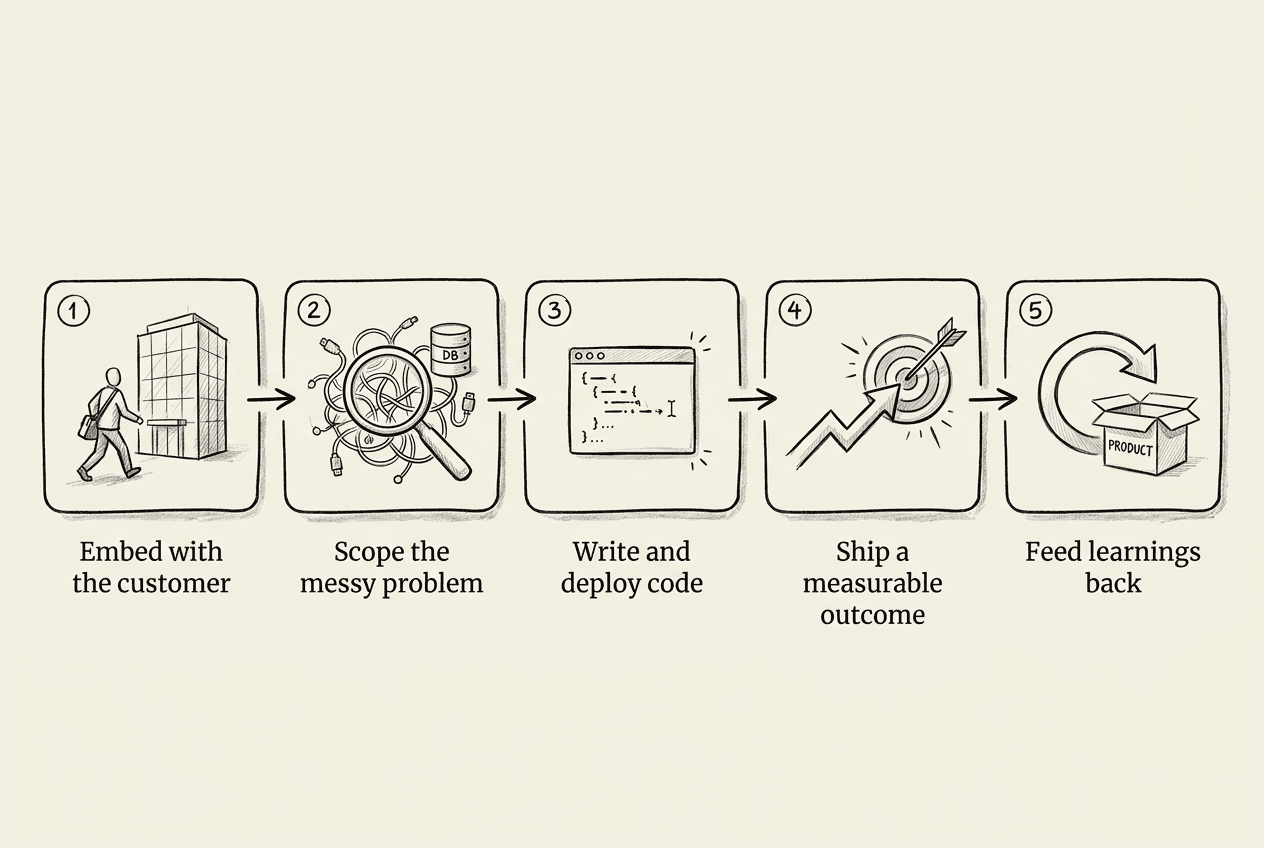
A Forward Deployed Engineer is an engineer who works directly inside a customer's organization and owns technical success from start to finish: scoping the problem, writing the code, deploying the system, and feeding what they learn back into the product.
The phrase comes from the military, where "forward deployed" means working at the point of action instead of from a base in the rear. For an engineer it means leaving headquarters and living inside the customer's reality: their data, their security rules, their legacy systems, their deadlines.
Palantir built the model. It put its own engineers inside client facilities for weeks or months at a time, writing production code, debugging pipelines on classified hardware, and sitting in customer standups. Until 2016, Palantir had more Forward Deployed Engineers than software engineers.
A solutions architect gives the customer a test drive. An FDE hands over the keys.
What does a Forward Deployed Engineer actually do?
The work runs the whole length of a deployment. A typical day might open with a customer standup to map out where things are breaking, move into an afternoon of writing Python to connect a model to a legacy ERP, and close with an evening spent fixing an integration that fell over at 2 a.m. in the customer's time zone.
The skills companies want in 2026 sit close to agentic AI:
- RAG pipelines: retrieval tuning, grounding, and context management
- Evaluation frameworks: eval suites that catch hallucinations and grounding failures before they reach production
- Agent development: real experience with LangGraph, LangChain, CrewAI, and DSPy, and with multi-step tool use
- Production observability: monitoring probabilistic systems that fail in ways ordinary software never does
One part of the job gets overlooked. Because the FDE sees what actually breaks in the field, they end up acting as a product manager whose input is grounded in real usage rather than guesswork. That feedback loop is a big reason the role is worth the cost.
Forward Deployed Engineer vs. Solutions Architect vs. CSM
The line between these roles comes down to who writes and ships production code.
| Role | Writes production code | Deploys in customer env | Owns the relationship |
|---|---|---|---|
| Forward Deployed Engineer | Yes | Yes | Shared |
| Solutions Architect | Rarely | Designs, rarely deploys | Shared |
| Customer Success Manager | No | No | Yes |
The FDE ships the code. The solutions architect designs the system but usually does not deploy it. The CSM owns the relationship but does not commit code.
Why are OpenAI, Anthropic, and Databricks hiring FDEs in 2026?
Because the bottleneck in enterprise AI is deployment, not the model, and in 2026 the major labs decided to own that bottleneck themselves.
The numbers are hard to argue with. MIT NANDA's State of AI in Business 2025 report found that 95% of enterprise generative AI pilots produced no measurable business impact. In most cases the model was fine. The deployment was where things fell apart.
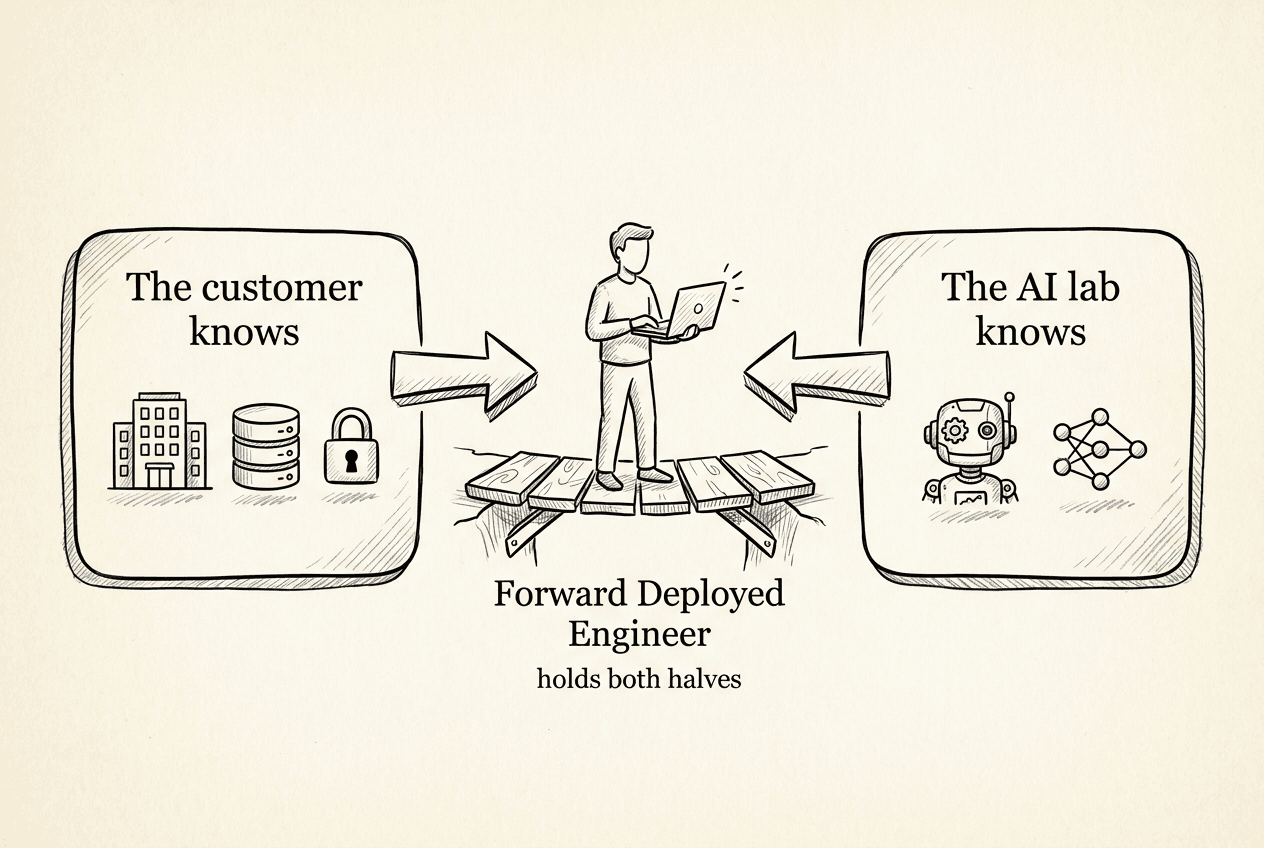
A lot of that comes down to what people call the two-sided knowledge gap. The customer's engineers understand the business: the data schemas, the compliance rules, the legacy architecture. The lab's engineers understand how models behave once they are live: prompting, RAG, evaluation, failure modes. Neither side can ship something that works on its own. The FDE is the person who holds both halves.
Agents make this harder. A deterministic SaaS product gets configured. An AI agent has to be adapted to a real human workflow, which is messy and full of judgment calls. That is why the labs moved at almost the same time:
- OpenAI launched The Deployment Company on May 11, 2026, with more than $4B in committed capital, and bought Edinburgh's Tomoro to bring roughly 150 experienced FDEs in from day one.
- Anthropic announced a $1.5B joint venture with Blackstone and Goldman Sachs within days.
- Databricks formalized its own Forward Deployed Engineering org on June 11, 2026, replacing consultant-style handoffs with engineers who build what isn't there yet.
It goes well beyond the frontier labs. As of late May 2026 there were 224 open FDE roles across 39 companies, with Palantir, Mistral, Cohere, Cresta, Scale AI, Snowflake, GitLab, and Stripe all hiring.
How much do Forward Deployed Engineers get paid?
FDE pay is high because the people who can do the job well are rare and the work matters. Reported base-salary ranges for 2026:
| Company | Base salary range |
|---|---|
| Palantir | $170K – $340K+ |
| OpenAI | $220K – $280K |
| Anthropic | $200K – $300K |
The money comes with real costs. Travel often runs 25% to 50% of the job, which wears people down faster than a desk role, and you are constantly switching between customer industries.
The payoff is career leverage. A few months as an FDE packs in years of customer exposure, which is why so many of them leave to start companies. Palantir alumni alone went on to found Anduril, OpenGov, and Addepar.
Can AI agents replace Forward Deployed Engineers?
No. The role is not being automated away. It is being amplified. The same engineers who close the demo-to-production gap are starting to pair with AI agents, and the result is one person who can ship far more, not one person replaced by a script.
A large part of the FDE's week is routine: running discovery interviews, scaffolding a prototype, wiring up yet another integration, writing the first pass of an eval suite. An AI teammate can take on that work under the engineer's direction. The FDE stays in the driver's seat for the parts that actually need judgment: the architecture, the customer relationship, and the call on what is good enough to ship.
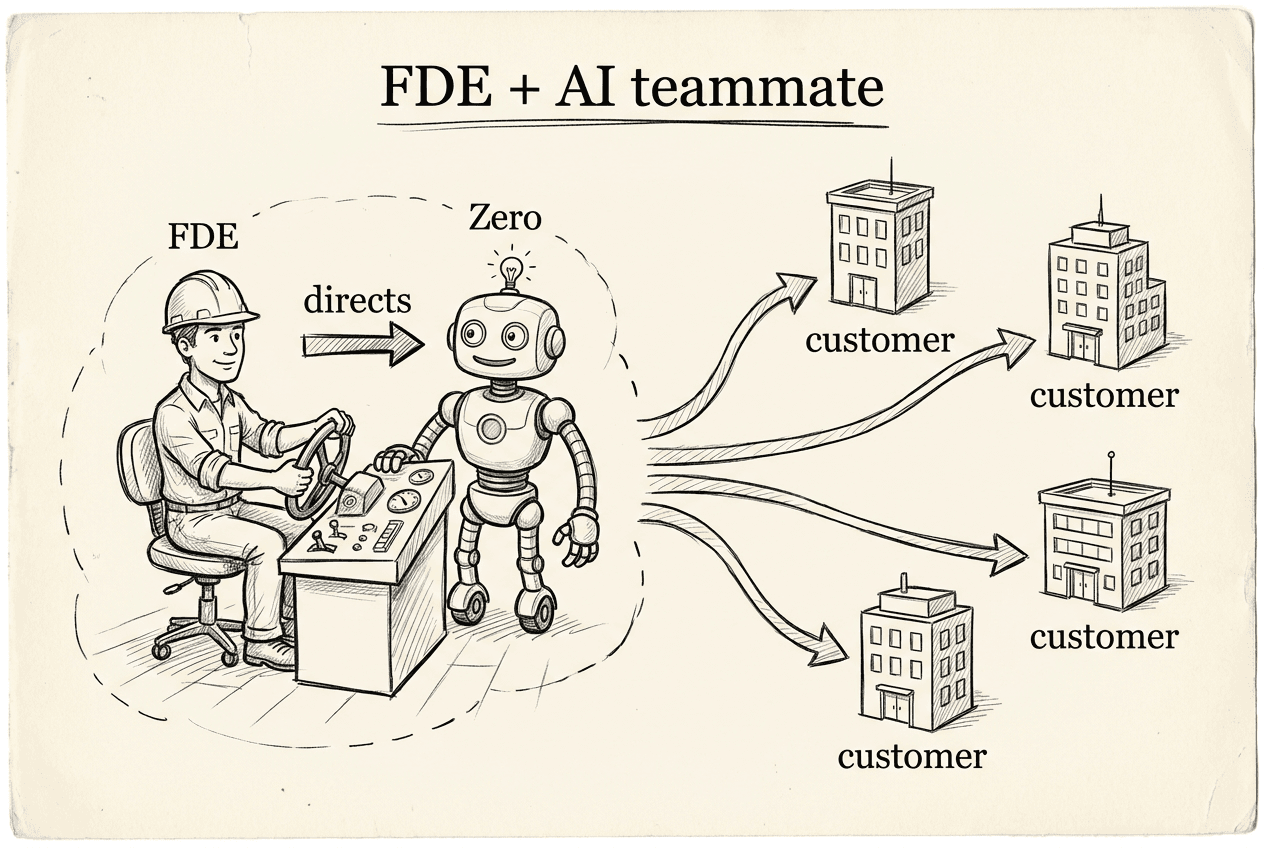
That teammate is what Zero is built to be. It runs where the team already works, connects to the systems already in use, and takes a task from problem to a usable result, while the engineer reviews, corrects, and decides what ships. The FDE is not handed off to software. The FDE drives the software, and together they cover far more ground than either could alone. One engineer who can direct a fleet of agents can serve many customers at once without giving up the judgment that made the role work in the first place.
The future of the role (2027 and beyond)
The title will probably split apart. Right now "Forward Deployed Engineer" covers a lot of different jobs. By mid-2027 expect cleaner subspecialties: FDE-Infrastructure, FDE-Eval, FDE-Agent, and FDE-Sovereign, the last one driven by sovereign AI, where companies want to own their data, models, and stack instead of running everything in someone else's cloud.
The role is not going away. The biggest, highest-stakes deployments will always want a person who can sit in the room. What shifts is where the leverage comes from. It moves from headcount toward software, and the FDE spends less time hand-building integrations and more time directing the agents that build them.
Frequently asked questions
Is a Forward Deployed Engineer a software engineer or a consultant? A software engineer. The whole point of the role is that they write, debug, and ship production code inside the customer's environment. They are not sales reps or consultants.
What skills do you need to become a Forward Deployed Engineer? Solid software engineering, plus the 2026 agentic stack: RAG pipelines, evaluation frameworks, agent development (LangGraph, CrewAI, DSPy), and production observability. Customer-facing judgment matters just as much, since you often work alone inside an unfamiliar company.
Which companies hire Forward Deployed Engineers? Palantir started it. In 2026, OpenAI, Anthropic, Databricks, Mistral, Cohere, Scale AI, Snowflake, GitLab, and Stripe are all hiring, along with more than a hundred others. There were 224 open roles across 39 companies as of late May 2026.
What is the difference between a Forward Deployed Engineer and an AI Engineer? An AI Engineer usually builds models and AI features inside their own company's product. A Forward Deployed Engineer takes those capabilities into a customer's environment and owns the last mile to a working result.
Will AI agents replace Forward Deployed Engineers? No. The work splits differently. AI agents take on routine discovery, prototyping, and integration under the engineer's direction, while the Forward Deployed Engineer keeps the judgment calls, the architecture, and the customer relationship. The role is moving toward piloting AI teammates, not competing with them.


