Events turned out to be the best user research I've ever run. Two of them taught me more about who we're building for than 22 interviews ever could.
TL;DR. A few weeks ago I wrote about why so many people still can't automate their work, even with AI everywhere. We'd found four barriers, and the first one sits underneath all the others: most people honestly can't see what to automate in the first place. Then I gathered two small groups into a room and watched that barrier quietly come down in a single afternoon. It changed how I think about who these tools are really for.
At one of the workshops, I put one question up on the screen and held my breath a little: "If you could wave a magic wand and fix one thing about your workflow, what would it be?"
I'd set it up as a live word cloud, so everyone's answer would appear together as they typed. The screen filled up. And the two biggest words on it could not have been more different.
One, in blue: autofix github pr. The other, in red: I don't know.
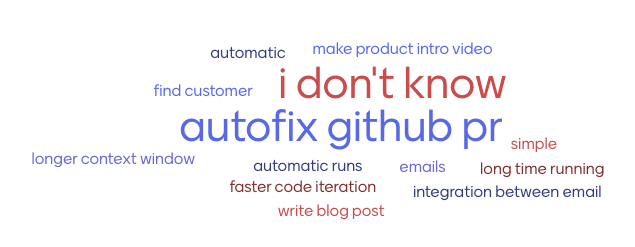
I keep coming back to that picture, because it's really two kinds of people sitting in the same room. One kind types "autofix github pr" without even pausing. They already know exactly what they'd hand off, and honestly, they don't need me. The other kind looked at the very same question and, with complete honesty, wrote "I don't know."
If that second answer is yours, don't worry at all. "I don't know" does not mean you're behind the people typing in blue. It means you're exactly the person I wrote this for. Not knowing what to automate isn't a gap in you. It was the very first barrier we named last time, and it's the thing I'd love to work through with you, together.
Three weeks ago we published "Why Can't You Automate Your Workflow?" After 22 interviews, we'd boiled the problem down to four barriers and given them names. But naming a thing doesn't loosen its grip, and I knew that. So I tried something that felt a little scary for me: instead of interviewing people through a screen, I invited them into a room. A dozen folks at one, about ten at the other. I just wanted to see what would actually help.
Here's what they taught me.
1. The "I don't know" gap is shorter than I thought.
I taught a small framework, maybe twenty minutes of it, in two parts.
THE FRAMEWORK 4 signals that a task is worth handing off:
- It's repetitive.
- It's glue work: moving information between tools, adding nothing of your own.
- The inputs and outputs are predictable.
- It's outside your skill but inside your judgment.
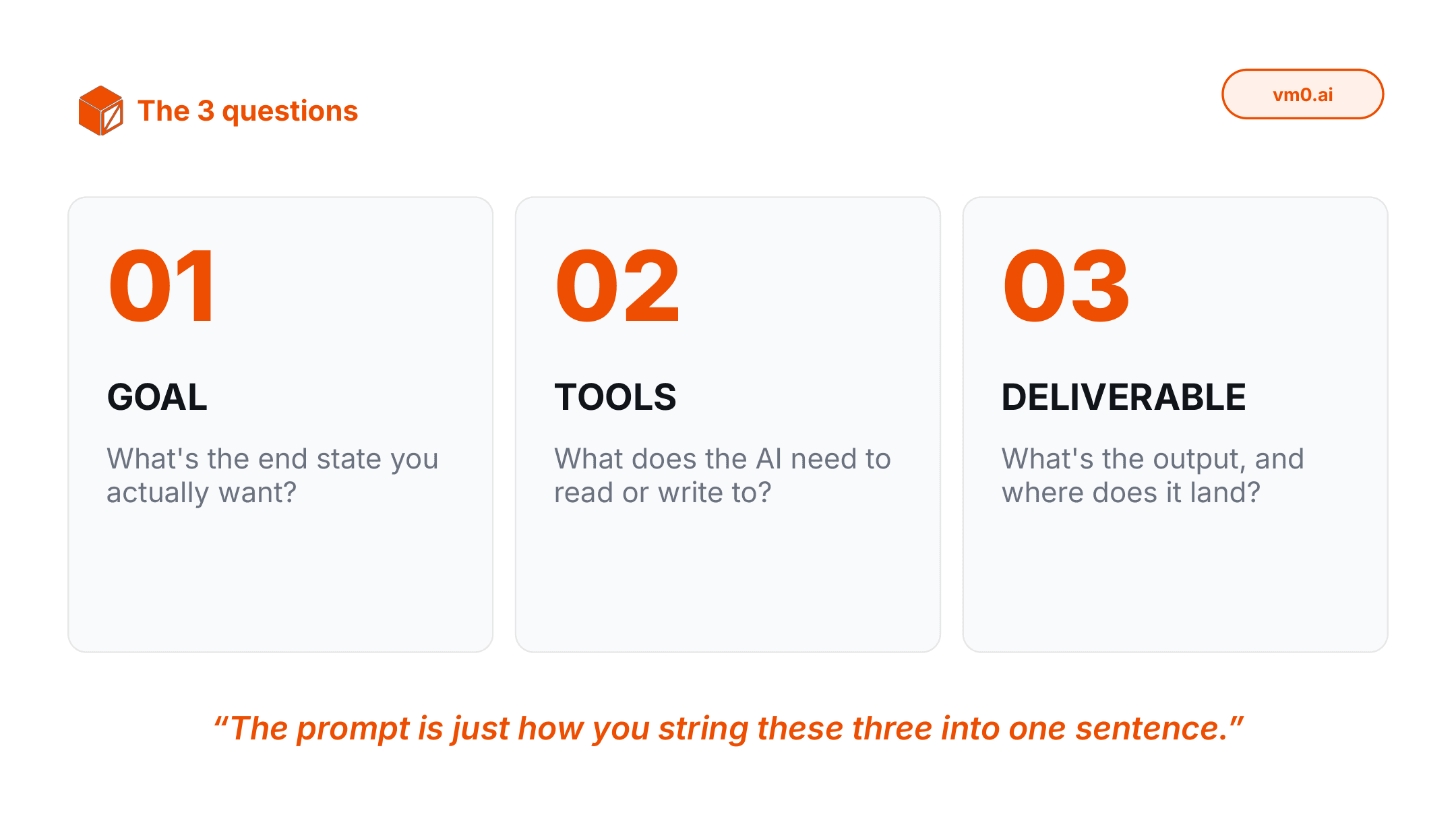
If a task hits two or more, build for it. 3 questions that turn that task into something an AI can run:
- Goal: what end state do you actually want?
- Tools: what does it need to read from or write to?
- Deliverable: what's the output, and where does it land?
The prompt is just those three answers strung into one sentence.
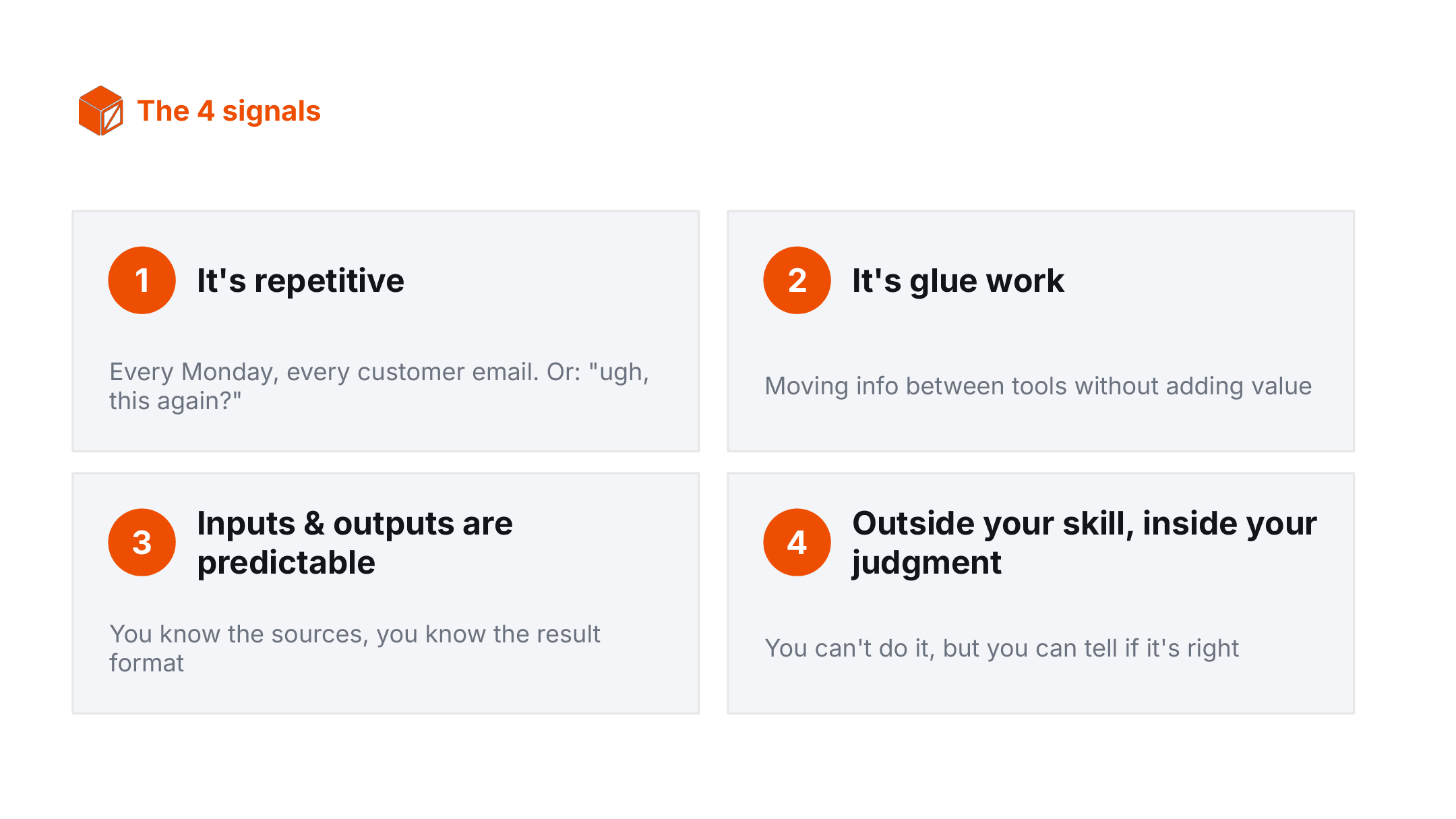
Then I asked people who came: pick three tasks from your own week that hit two or more of these signals, you've got five minutes. And the loveliest thing happened. Nobody said "I don't know" anymore. The same room that couldn't name a single task ten minutes earlier was suddenly full of people who could. The gap I'd been writing about for three months, the one I'd quietly started to believe was the hard, permanent part, just closed over an afternoon.
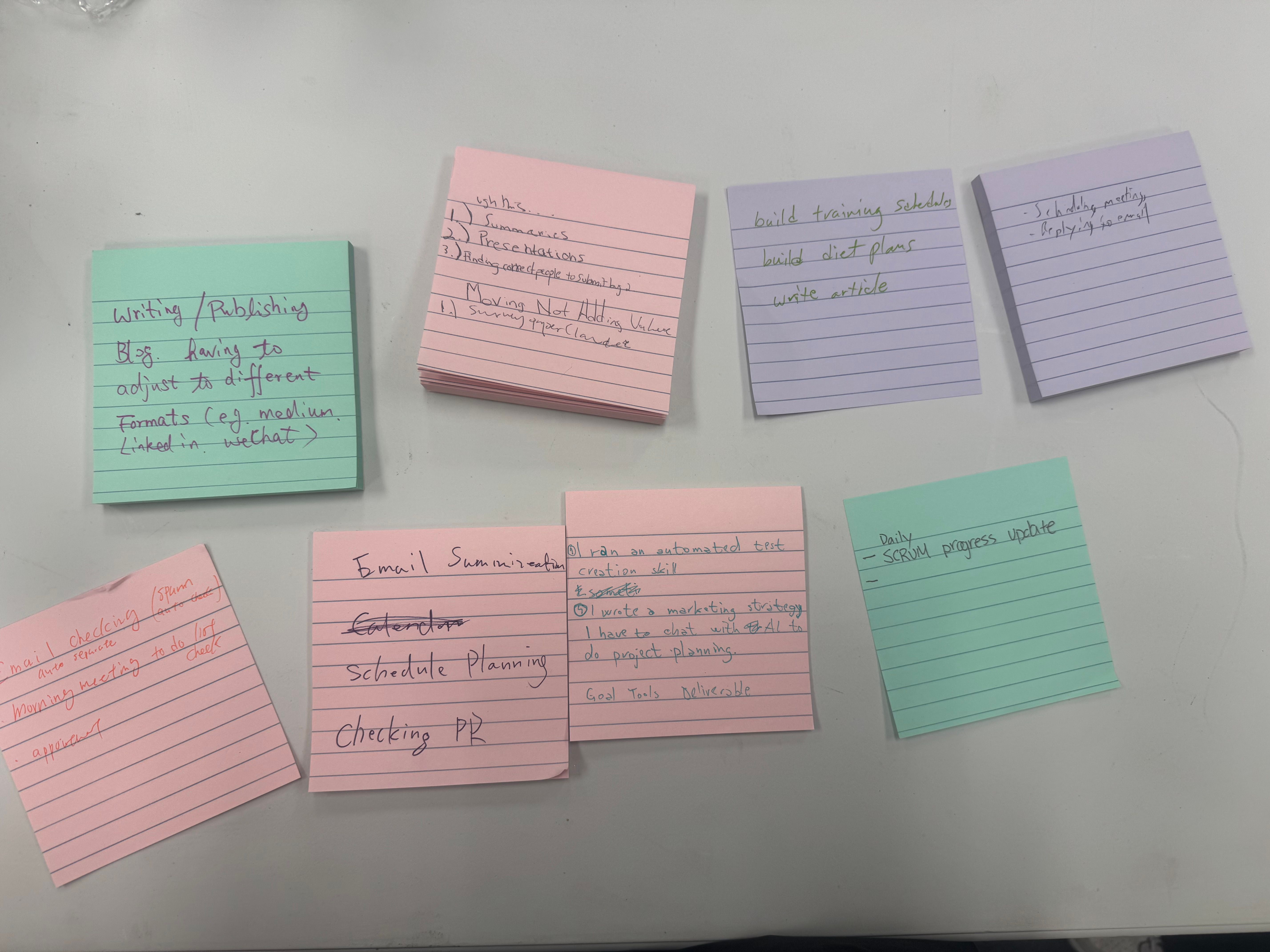
If that red-word feeling is yours, this framework is the way through, and it's so much gentler than it looks. One man, running his family's business from overseas, was drowning in customer email. He walked it through the three questions: the goal, just to stop drowning in his inbox; the tools, his Gmail; the deliverable, every message sorted by language with the urgent ones floated to the top. And that was it. A foggy "my inbox is a mess" became one clear, buildable sentence, the kind you could genuinely hand to an AI teammate and get somewhere with. He'd never have called any of that "automation" that morning. You have a task like his. Almost all of us do.
2. The framework worked best on people I least expected.
I'll be honest about what I expected walking in. I assumed the people who'd get the most out of this would be the engineers, the ones who type "autofix github pr" without blinking. I had it completely backwards, and I'm so glad I did.
A gym owner who'd only recently started running his own website watched a traffic problem he'd been stuck on for weeks turn into something he could finally fix himself. By the end he was already talking about putting real money behind the tools.
And a life coach carried her laptop over to me and asked, a little tentatively, one question: how would you set this up? I never quite got to answer her, because by the end of the day two founders had pulled their chairs in on either side of her and were walking her through it themselves. Nobody asked them to. They just wanted to help.
I think about that last moment a lot. It's the clearest picture I have of how this really spreads, one person quietly turning to help the next.
3. The format mattered more than I realized.
That was the thing a room had that a video call never gave me. People carrying the same quiet struggle, finding each other. Someone would describe their workflow out loud, and a man two seats over would light up and say, "oh, I do that every Monday, here's how I handle it." Honestly, the framework was mostly just an excuse, a reason for the room to start teaching itself. And that's where most of the real unsticking happened, between strangers, not from me at the front. If you feel stuck on what to automate, sometimes all it takes is hearing one other person describe a week that looks like yours.
4. This one's for you.
Come back to that word cloud with me. The people typing "autofix github pr" already knew what to fix. The part the rest of the room got stuck on, just seeing what to hand off in the first place, was never really their problem, so my little framework didn't have much to offer them. A few of the most experienced engineers smiled kindly and drifted back to their own setups, and that's completely fair. One of them even stopped to ask me, quite gently, who our target user actually was. She wasn't being difficult. She was just right that it wasn't her.
The warmth in the room came from the other side of it. An early-stage founder filmed my whole lead-generation demo on her phone, because finding customers is the thing keeping her up at night right now, and afterward she chased me down just to ask how to begin. People like her didn't have to unlearn anything first. The moment I showed them those four signals, half their week lit up in front of them. They hadn't come to write code. They'd come to get their week back.
So if you've read this far and almost none of it has sounded like code, please know that isn't an accident. I wrote this for you.
What's next
I don't want to oversell any of this to you. The people who need this most still need real support to keep going once they leave the room, and figuring out how to give them that is exactly what we're working on next.
But you don't have to wait for a room, or for us. If "I don't know" is still where you are tonight, that's okay, truly, it's where nearly all of us start. Just take the one task from your week that hit two of those four signals, and answer those three questions for it, in a single plain sentence. That sentence really is the whole on-ramp. Hand it to an AI teammate and see what comes back. And if you'd like to try it with ours, it's called Zero, over at vm0.ai.
Or, if you'd rather not do it on your own, come and build it next to other people figuring out the very same thing. We're running the next workshop in two weeks, and I'd genuinely love to see you there. Follow @vm0_ai on X for the RSVP, and come say hi.