
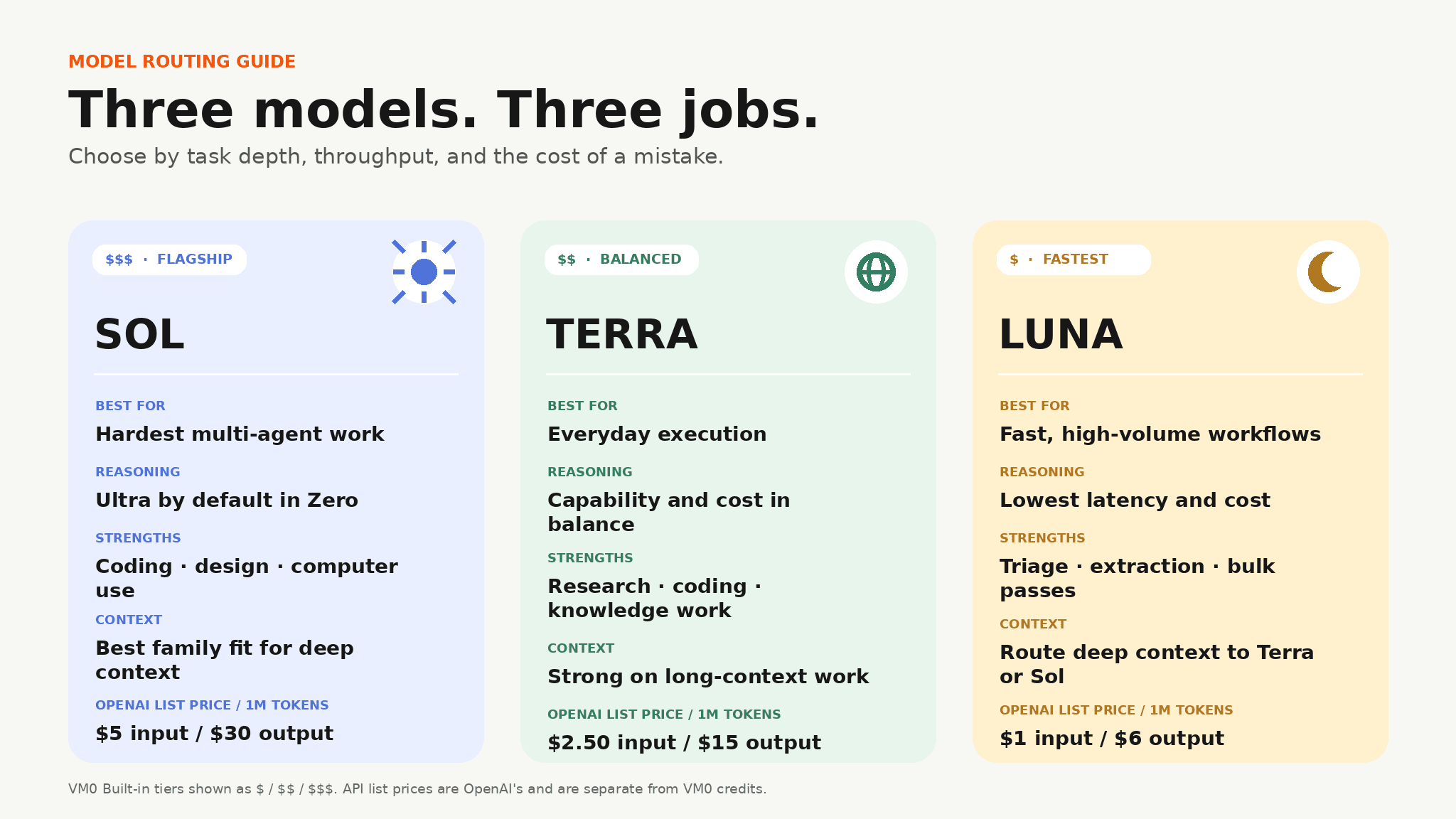
GPT-5.6 is now built into Zero as a three-model family: Sol for the hardest multi-agent work, Terra for balanced everyday execution, and Luna for fast, high-volume workflows.
For teams routing varied agent workloads, that can be more useful than a single new flagship. Instead of paying for maximum reasoning on every step, you can match the model to the job while keeping the same Zero environment around it: connected tools, files, browser access, isolated execution, skills, and follow-through.
Choose the Built-in route and VM0 manages the model access and bills usage in credits. If your team already uses an OpenAI API key or a ChatGPT/Codex subscription, Zero supports those routes too.
One family, three operating points
OpenAI designed GPT-5.6 around durable capability tiers. The number identifies the generation; Sol, Terra, and Luna describe the trade-off between intelligence, speed, and cost.
GPT-5.6 Sol: the hardest work
Sol is the flagship. Reach for it when a task is difficult enough that a stronger plan, more checking, or parallel work can materially change the outcome.
Zero's GPT-5.6 Sol integration uses Ultra reasoning by default. OpenAI describes Ultra as coordinating four agents in parallel, then synthesizing their work. That makes Sol a strong fit for assignments with several independent workstreams, such as:
- Migrating a large codebase while testing compatibility and documenting the result.
- Researching a market across many sources, challenging the findings, and producing a decision-ready brief.
- Turning a product brief into a polished interface, inspecting the rendered result, and fixing visual or functional issues.
- Investigating a production incident across logs, code, tickets, and browser state before proposing a fix.
Sol carries the $$$ VM0 Built-in tier. Use it where a wrong turn is expensive, not for every short reply.
GPT-5.6 Terra: the balanced workhorse
Terra is the sensible starting point for repeatable professional work. OpenAI positions it as the balanced tier and reports performance competitive with GPT-5.5 at half the listed API token price.
Use Terra for work that still needs reasoning and tool use but does not require Sol's maximum compute:
- Daily research, competitor monitoring, and multi-source summaries.
- Routine code changes, pull-request analysis, and issue investigation.
- Drafting reports, launch plans, customer briefs, and operational documents.
- Agent workflows that need strong long-context handling at a more moderate cost.
Terra carries the $$ VM0 Built-in tier. It is not forced as a universal default; it is simply the tier we would test first for many general-purpose workflows.
GPT-5.6 Luna: speed and volume
Luna is the fastest and most affordable member of the family. It is built for work where throughput and response time matter more than maximum depth.
Good Luna workloads include:
- Classifying or routing large batches of tickets, leads, or messages.
- Extracting structured fields from consistent documents.
- Running first-pass triage before promoting ambiguous cases to Terra or Sol.
- Producing short summaries or transformations at high volume.
Luna carries the $ VM0 Built-in tier. It is not the right choice for every cheap task: OpenAI's own long-context evaluation shows a large gap between Luna and the two larger tiers on retrieval across very large inputs. Route deep, ambiguous context to Terra or Sol.
What the benchmarks do—and do not—say
OpenAI reports strong results across the family, but the useful story is the shape of the trade-off rather than a single leaderboard position.
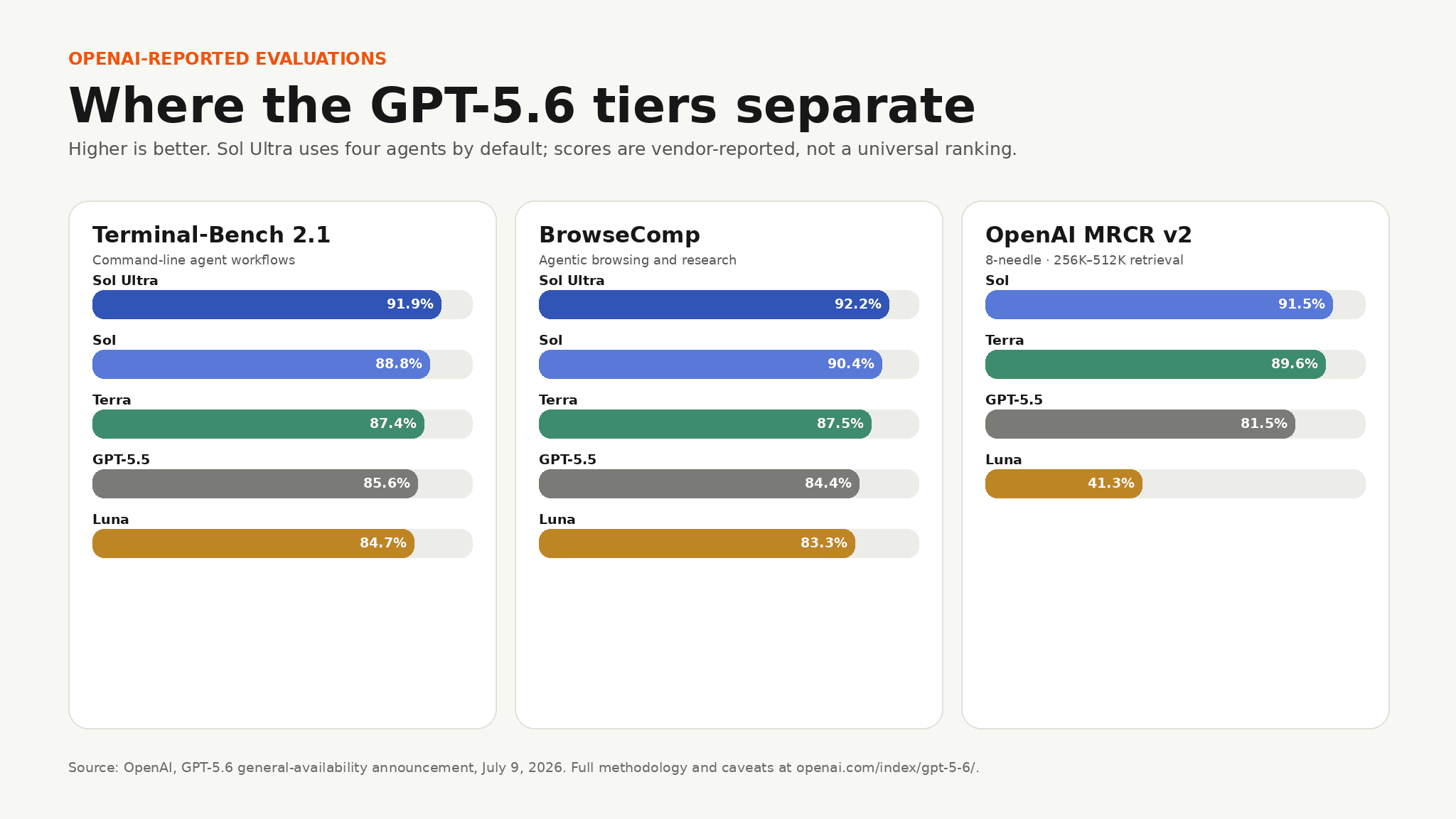
On Terminal-Bench 2.1, which evaluates command-line agent workflows, OpenAI reports 91.9% for Sol Ultra, 88.8% for Sol, 87.4% for Terra, and 84.7% for Luna. On BrowseComp, the reported scores are 92.2% for Sol Ultra, 90.4% for Sol, 87.5% for Terra, and 83.3% for Luna.
The long-context result is the more important routing signal. On OpenAI MRCR v2, 8-needle, 256K–512K, Sol scores 91.5% and Terra 89.6%, while Luna scores 41.3%. Luna can still be excellent for short, repeated work; it just should not be treated as a smaller Sol for every workload.
These are vendor-reported evaluations, not a universal ranking. Benchmarks measure particular harnesses, tools, reasoning settings, and budgets. Your own workflow can reverse the order, so re-run a representative task before changing a production agent.
GPT-5.6 vs GPT-5.5 and Claude Fable 5
The practical comparison is not “which model wins?” It is “which behavior is worth paying for at this stage of the run?”
| Model | Best fit in Zero | What stands out | VM0 Built-in tier |
|---|---|---|---|
| GPT-5.6 Sol | Hard, multi-stage work where planning, parallel execution, design judgment, or validation can change the result | Zero uses Ultra by default; strongest GPT-5.6 tier for coding, computer use, design, research, and deep context | $$$ |
| GPT-5.6 Terra | Everyday professional workflows that still need reliable reasoning and tools | Balanced quality, speed, and cost; strong family fit for long-context work | $$ |
| GPT-5.6 Luna | Fast, high-volume work with consistent inputs and easy escalation | Lowest latency and cost in the family; ideal for triage, extraction, and bulk passes | $ |
| GPT-5.5 | Existing OpenAI workflows that are already validated and do not yet need re-baselining | Familiar frontier behavior and a stable comparison point for current agents | Availability depends on workspace configuration |
| Claude Fable 5 | The deepest Anthropic and Claude Code workflows, especially where a team is already tuned to its behavior | Premium long-horizon reasoning and a distinct provider/tooling profile | $$$$ |
OpenAI reports that Sol leads Fable 5 on Agents' Last Exam and the Artificial Analysis Coding Agent Index, while Fable 5 remains slightly ahead on GDPval-AA v2. That is exactly why “best model” is too broad a claim. Sol is compelling when you want OpenAI's strongest agentic coding, computer-use, design, and multi-agent behavior. Fable remains a valid choice for top-end Anthropic work and workflows already calibrated around Claude Code.
Terra is the more direct upgrade candidate for many GPT-5.5 workloads: OpenAI says it is competitive with GPT-5.5 at half the listed API token price. Luna is a different optimization target—speed and scale—so compare it on completed work per dollar or per minute, not only on peak benchmark scores.
What Built-in means in Zero
Built-in makes GPT-5.6 a routing choice instead of a credential project. Select the VM0 Managed provider and Zero handles access while charging the corresponding VM0 credit tier. You do not need to create or maintain a separate OpenAI API key for that route.
Teams that prefer their own provider relationship can still use an OpenAI API key or connect a ChatGPT/Codex subscription. The model name stays the same; the billing path and provider configuration change. VM0 credit tiers ($, $$, $$$) are not the same as OpenAI's public API token prices.
How to turn on GPT-5.6 in Zero
GPT-5.6 is selected in model settings, not by writing “use GPT-5.6” inside a prompt.
- Open Settings and choose Models from the sidebar.
- In the Personal section, add GPT 5.6 Sol, GPT 5.6 Terra, or GPT 5.6 Luna.
- Choose Built-in to use VM0 Managed routing, or select your connected OpenAI API or ChatGPT/Codex provider.
- Start a chat or run, open the model picker, and switch to the tier you want.
- Once a workflow is stable, set the appropriate model at the agent or skill level so routine work uses the intended route consistently.
A practical routing playbook
Start by asking three questions:
- How expensive is a wrong answer? Use Sol when errors create meaningful rework, risk, or downstream impact.
- How deep and ambiguous is the context? Use Terra or Sol for large, messy inputs that require cross-checking and synthesis.
- How often will this run? Use Luna for high-volume, predictable work, then escalate exceptions.
A mixed routing pattern is worth testing: Luna filters and structures the input, Terra completes the main body of work, and Sol handles the few decisions that justify maximum reasoning. You do not need one model to do everything; you need each stage to use enough model.
GPT-5.6 makes that choice unusually clear. Sol, Terra, and Luna give Zero three operating points inside the same agent environment—so you can scale capability up when the work demands it and scale cost down when it does not.


